 |
| Source: http://www.google.it/logos/2011/italyculture11-hp.png |
Showing posts with label Italy. Show all posts
Showing posts with label Italy. Show all posts


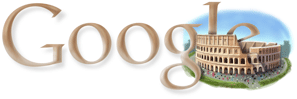
140th Anniversary of Rome
Today the Google Logo has one of it’s changes on and it’s to celebrate 140 years of Rome the Capital of Italy.
The 20th September 1870 the “Bersaglieri Troupes” entered the City of Rome through Porta Pia, under the command of General Luigi Cadorna. Actually they broke through a breach in the “Mura Aureliane”, near Porta Pia.
At this point Pope Pio or Pius IX declared himself prisoner of The Vatican, and Rome became part of the Reign of Italy and was declared Capital. The day before Capital was Florence.
 |
| Source: http://www.google.com/logos/2010/rome10-hp.gif |
The 20th September 1870 the “Bersaglieri Troupes” entered the City of Rome through Porta Pia, under the command of General Luigi Cadorna. Actually they broke through a breach in the “Mura Aureliane”, near Porta Pia.
At this point Pope Pio or Pius IX declared himself prisoner of The Vatican, and Rome became part of the Reign of Italy and was declared Capital. The day before Capital was Florence.
Doodle4Google World Cup Winner
 |
| UAE - Source: http://www.google.com/logos/d4g_worldcup10_uae-hp.jpg |
 |
| Netherlands - Source: http://www.google.com/logos/d4g_worldcup10_nl-hp.jpg |
 |
| Kenya - Source: http://www.google.com/logos/d4g_worldcup10_ke-hp.jpg |
 |
| Italy - Source: http://www.google.com/logos/d4g_worldcup10_it-hp.jpg |
 |
| Israel - Source: http://www.google.com/logos/d4g_worldcup10_il-hp.jpg |
 |
| Czech Republic - Source: http://www.google.com/logos/d4g_worldcup10_cz-hp.jpg |
 |
| Taiwan - Source: http://www.google.com/logos/d4g_worldcup10_tw-hp.jpg |
 |
| Hong Kong - Source: http://www.google.com/logos/d4g_worldcup10_hk-hp.jpg |
Republic Day
 |
| Source: http://www.google.com/logos/republicdayit10.gif |
After 85 years of monarchy, with 12,717,923 votes for and 10,719,284 votes against, Italy became a Republic, and the monarchs of the House of Savoy were deposed and exiled. This is one of the most important Italian public holidays which, like July 14 in France and July 4 in the USA, celebrates the birth of the nation. A grand military parade is held in central Rome.
Alessandro Manzon's Birthday
 |
| Source: http://www.google.com/logos/manzoni2010-hp.gif |
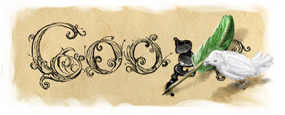
Manzoni was born in Milan, Italy, on 7 March 1785. Pietro, his father, aged about fifty, belonged to an old family of Lecco, originally feudal lords of Barzio, in the Valsassina. The poet's maternal grandfather, Cesare Beccaria, was a well-known author, and his mother Giulia had literary talent as well. The young Alessandro spent his first two years of life in cascina Costa in Galbiate and he was wet-nursed by Caterina Panzeri, as attested by a memorial plate affixed in the place. In 1793 his parents broke their marriage and his mother began a relationship with the highbrow Carlo Imbonati, moving to England and later to Paris. For this reason, their son was brought up in several religious institutes. Alessandro Manzoni was a slow developer, and at the various colleges he attended he was considered a dunce. At fifteen, however, he developed a passion for poetry, and wrote two sonnets of considerable merit. Upon the death of his father in 1805, he joined the freethinking household of his mother at Auteuil, and spent two years mixing with the literary set of the so-called "ideologues", philosophers of the 18th-century school, among whom he made many friends, notably Claude Charles Fauriel. There too he imbibed the anti-Catholic creed of Voltairianism. [Read more on Wikipedia]


Giuseppe Verdi's Birthday
 |
| Source: http://www.google.com/logos/verdi09.gif |
 |
| Giuseppe Verdi. Portrait by Giovanni Boldini, 1886 |
Giuseppe Verdi's Birthday

Google Italy Logo - Giuseppe Verdi's Birthday
400th Anniversary of Galileo's Telescope

Google logo - Galileo's Telescope
Description from wiki
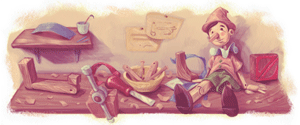
Anniversary of the publication of Pinocchio
 |
| Source: http://www.google.com/logos/pinocchio09.gif |


Subscribe to:
Posts (Atom)


