Showing posts with label Taiwan. Show all posts

Zhang Daqian's 112th Birthday


Chang Dai-chien (May 10, 1899 – April 2, 1983) was one of the best-known and most prodigious Chinese artists of the twentieth century. Originally known as a guohua (traditionalist) painter, by the 1960s he was also renowned as a modern impressionist and expressionist painter. Chang is regarded as one of the most gifted master forgers of the twentieth century. [Read more on Wikipedia]

Happy Children's Day!

Source: http://www.google.com.tw/logos/2011/childrensday11-hp.png

Bruce Lee's Birthday

Source: http://www.google.com.tw/logos/2010/brucelee2010-hp.jpg
Bruce Lee (born Lee Jun-fan; 27 November 1940 – 20 July 1973) was a Chinese American and Hong Kong actor, martial arts instructor, philosopher, film director, film producer, screenwriter, and founder of the Jeet Kune Do martial arts movement. He is considered one of the most influential martial artists of the 20th century, and a cultural icon.

Lee was born in San Francisco, California in the United States, to parents of Hong Kong heritage but raised in Hong Kong until his late teens. Upon reaching the age of 18, Lee emigrated to the United States to claim his U.S. Citizenship and receive his higher education. It was during this time he began teaching martial arts, which soon led to film and television roles.

His Hong Kong and Hollywood-produced films elevated the traditional Hong Kong martial arts film to a new level of popularity and acclaim, and sparked a major surge of interest in Chinese martial arts in the West in the 1970s. The direction and tone of his films changed and influenced martial arts and martial arts films in Hong Kong and the rest of the world as well. He is noted for his roles in five feature-length films, Lo Wei's The Big Boss (1971) and Fist of Fury (1972); Way of the Dragon (1972), directed and written by Lee; Warner Brothers' Enter the Dragon (1973), directed by Robert Clouse; and The Game of Death (1978), directed by Lee.

Lee became an iconic figure known throughout the world and remains very popular among Asian audience and in particular among the Chinese, as he portrayed Chinese nationalism through his films While Lee initially trained in Wing Chun, he later rejected well-defined martial art styles, favouring instead to utilise useful techniques from various sources in the spirit of his personal martial arts philosophy he dubbed Jeet Kune Do (The Way of the Intercepting Fist). [Read more on Wikipedia]

Sun Yat-sen's birthday

Source: http://www.google.com.tw/logos/2010/yatsen10-hp.jpg
Sun Yat-sen (pinyin: Sūn Yìxiān; 12 November 1866 – 12 March 1925) was a Chinese revolutionary and political leader. As the foremost pioneer of Nationalist China, Sun is frequently referred to as the Founding Father of Republican China, a view agreed upon by both Mainland China and Taiwan. Sun played an instrumental role in inspiring the overthrow of the Qing Dynasty, the last imperial dynasty of China, which began in October 1911. He was the first provisional president when the Republic of China (ROC) was founded in 1912 and later co-founded the Chinese National People's Party or Kuomintang (KMT) where he served as its first leader. Sun was a uniting figure in post-Imperial China, and remains unique among 20th-century Chinese politicians for being widely revered amongst the people from both sides of the Taiwan Strait.

Although Sun is considered one of the greatest leaders of modern China, his political life was one of constant struggle and frequent exile. After the success of the revolution, he quickly fell out of power in the newly founded Republic of China, and led successive revolutionary governments as a challenge to the warlords who controlled much of the nation. Sun did not live to see his party consolidate its power over the country. His party, which formed a fragile alliance with the Communists, split into two factions after his death. Sun's chief legacy resides in his developing a political philosophy known as the Three Principles of the People: nationalism, democracy, and the people's livelihood. [Read more on Wikipedia]

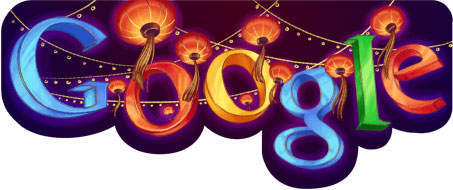
Mid Autumn Day 中秋节


Google China Logo -Mid Autumn Day 中秋节

The Mid-Autumn Festival, also known as the Moon Festival, or in Chinese, Zhongqiu Jie (traditional Chinese: 中秋節), is a popular harvest festival celebrated by Chinese people, Japanese people (Tsukimi festival in Japanese), Koreans (Chuseok festival in Korean), and Vietnamese people (even though they celebrate it differently), dating back over 3,000 years to moon worship in China's Shang Dynasty. It was first called Zhongqiu Jie (literally "Mid-Autumn Festival") in the Zhou Dynasty. In Malaysia, Singapore, and the Philippines, it is also sometimes referred to as the Lantern Festival or Mooncake Festival.

The Mid-Autumn Festival is held on the 15th day of the eighth month in the Chinese calendar, which is usually around late September or early October in the Gregorian calendar. It is a date that parallels the autumn and spring Equinoxes of the solar calendar, when the moon is supposedly at its fullest and roundest.

中秋节起源于中国,是东亚民间的一个传统节日,为每年农历的八月十五。中秋节不单单是华人的节日,受中华文化的影响,中秋节也是日本、越南、朝鲜半岛等地的传统节日。
按照中国的农历,八月为秋季的第二个月,古时称为仲秋,因此民间称为中秋,又称秋夕、八月节、八月半、月夕、月节,又因为这一天月亮满圆,象征团圆,又称为团圆节。

via wiki

Qi Xi

Source: http://www.google.com/logos/qixi09.gif
Qixi Festival (Chinese: 七夕节; Mandarin Pinyin: qī xī jié; Jyutping: cat1 zik6 zit3; literally "The Night of Sevens"), also known as Magpie Festival, falls on the seventh day of the seventh lunar month on the Chinese calendar; thus its name. It also inspired Tanabata (aka. Shichiseki [七夕]) in Japan, Chilseok (칠석) in Korea, and vi:Thất Tịch in Vietnam. It is sometimes called Chinese Valentine's Day (Simplified Chinese: 情人节 Pinyin: Qíng rén jié) since late 1990s. [Read more on Wikipedia]