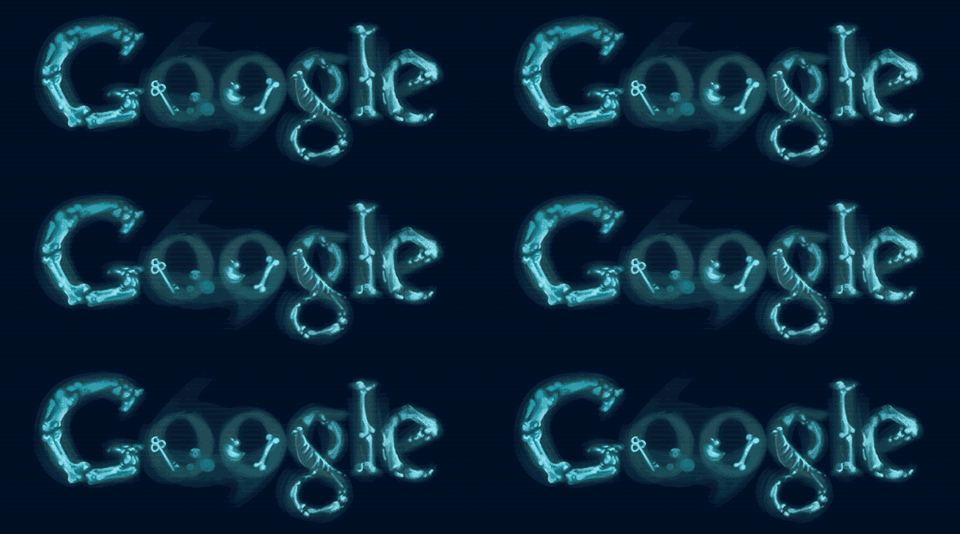
 |
| Source: http://www.google.com.vn/logos/2010/xraydiscovery2010-ps.gif |
Showing posts with label Scientific. Show all posts
Showing posts with label Scientific. Show all posts
115th Anniversary of the Discovery of X-rays
25th Anniversary of Buckyball
Google has released another interactive animated HTML5 Google Doodle today. Spotted first on Google.co.uk, Google logo is made up of interactive colored balls.
Google Doodles never came without a reason. Most recently, Google Doodle celebrated buckyball's 25th-anniversary by embracing the carbon molecule in its logo. But today's different. Google.co.uk users are treated to a special mystery Google Doodle today -- and there doesn't seem to be any occasion that Google's celebrating.
The new mystery Google Doodle on Google.co.uk replaces the Google logo with a string of tiny circles or balls that disperse upon mouse movement on the page. Move the mouse over the Google Doodle quickly or slowly and the balls/circles making up the Google logo disperse according to momentum -- it's pretty cool.
As with past interactive doodles, Google Doodle supports HTML5. We tried playing with Google Doodle on Google Chrome 6 and beta 7, Firefox 4 beta, and IE8 on Microsoft Windows 7. However, the Google Doodle didn't render at all on IE7 running on Microsoft XP.
Buckminsterfullerene (C60) is a spherical molecule with the formula C60. It was first prepared in 1985 by Harold Kroto, James Heath, Sean O'Brien, Robert Curl and Richard Smalley at Rice University.[1] Kroto, Curl, and Smalley were awarded the 1996 Nobel Prize in Chemistry for their roles in the discovery of buckminsterfullerene and the related class of molecules, the fullerenes. The name is an homage to Richard Buckminster Fuller, whose geodesic domes it resembles. Buckminsterfullerene was the first fullerene molecule discovered and it is also the most common in terms of natural occurrence, as it can be found in small quantities in soot. [Read more on Wikipedia]
Google Doodles never came without a reason. Most recently, Google Doodle celebrated buckyball's 25th-anniversary by embracing the carbon molecule in its logo. But today's different. Google.co.uk users are treated to a special mystery Google Doodle today -- and there doesn't seem to be any occasion that Google's celebrating.
The new mystery Google Doodle on Google.co.uk replaces the Google logo with a string of tiny circles or balls that disperse upon mouse movement on the page. Move the mouse over the Google Doodle quickly or slowly and the balls/circles making up the Google logo disperse according to momentum -- it's pretty cool.
 |
| Source: http://www.google.com/logos/2010/buckyball10-hp.gif |
Buckminsterfullerene (C60) is a spherical molecule with the formula C60. It was first prepared in 1985 by Harold Kroto, James Heath, Sean O'Brien, Robert Curl and Richard Smalley at Rice University.[1] Kroto, Curl, and Smalley were awarded the 1996 Nobel Prize in Chemistry for their roles in the discovery of buckminsterfullerene and the related class of molecules, the fullerenes. The name is an homage to Richard Buckminster Fuller, whose geodesic domes it resembles. Buckminsterfullerene was the first fullerene molecule discovered and it is also the most common in terms of natural occurrence, as it can be found in small quantities in soot. [Read more on Wikipedia]
400th Anniversary of Galileo's First Telescope
 |
| Source: http://www.google.com/logos/galileo09.gif |
Subscribe to:
Posts (Atom)


