Google's first doodle was a spur of the moment idea by Google founders, Larry Page and Sergey Brin. Today, Google logo doodles, which can be anything from a quick reaction to a news item to the anniversary of a scientific discovery, are so popular that the company hears from hundreds of thousands of users all over the world with suggestions, corrections, or, like one Japanese businessman, with a thanks "for bringing a small smile to my face every single day." Here, Dennis Hwang, Webmaster Manager, and Micheal Lopez, Senior Web Designer, share the stories behind a few notable doodles.
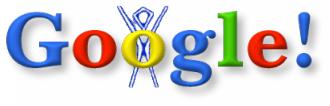
"Our first doodle went up when Larry and Sergey were running Google while it was in beta on their own," says Hwang. "It shows the Burning Man symbol, the annual alternative festival, which they like to go to whenever they can. They wanted to let the early Google search engine users know that the site would be running unattended while they were there. So they put this up—it's like a fun 'out of office' message."
"It was so popular they did one for Thanksgiving. In the early years, it was a controversial thing to do. If you read any kind of corporate marketing or branding textbook, the one thing they tell you is to make your corporate branding consistent no matter what. But Larry and Sergey said, 'Why not? We should have fun with this.' They did it in spite of some resistance within the company."
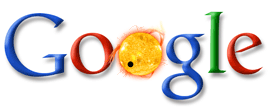
"Some of the ideas actually come from our users," says Hwang. "We got an email from a French astronomer who said we would be able to see the planet Venus crossing the face of the sun. We asked him when it was happening, he said 'tomorrow." We told him we didn't know if we could do it on such short notice. He replied, 'well, the next pair of transits is 122 years from now.' So in less than 24 hours we had a design up all around the world. People could see a black dot that would slowly move around the sun."
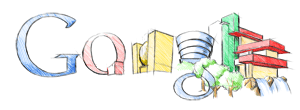
"To do the doodles we do a lot of research—we read, look at a lot of clips—we don't want to get anything wrong," says Hwang. "For Wright's birthday, this logo features works designed by him, including Fallingwater and the Guggenheim. But for the O, while it was loosely based on a building he did design, I had to take some artistic license. When the logo went live, architects around the world went on this chase to find this lost, unseen work by Wright. I felt so bad, we don't want to mislead the public! Every time you do one of these, you learn something."
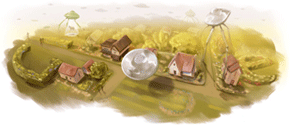
"This three-part series to celebrate H.G. Wells' birthday was pretty special for us, says Lopez. "We're all big fans of all things science, and H.G. Wells is one of the greatest science fiction writers of all time. So while we wanted to honor him, we thought, 'why not take it a step further?' Orson Welles did a radio play version of The War of the Worlds that gave listeners the mistaken impression that aliens were invading. We wanted to create a similar stir on the internet.
"So the first doodle we posted was a flying saucer, and we tweeted 'All your O are belong to us,' because the craft was taking away the O. If you're a geek on the internet you know it's a reference to a poorly translated Japanese game.
"Then the second we did these crop circles. And we tweeted the coordinates of the longitude and latitude of where Wells' aliens landed. By this time there were all these theories floating around on the internet—everything from 'Google's donated an O to a non-profit organization,' to 'Google's discovered that there actually were aliens.'
"The last doodle, posted on Wells' birthday, lets everyone in on the joke—we were just celebrating H.G. Wells."
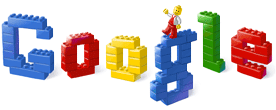
"In the early days Larry and Sergey used to build hard drive enclosures out of LEGO blocks—it was half fun, half functional," says Hwang. So when LEGO hit their 50th anniversary, it was a natural fit for us. We actually poured a bunch of LEGOs on the floor and built the logo out of LEGO in real life to figure out how to illustrate it correctly."
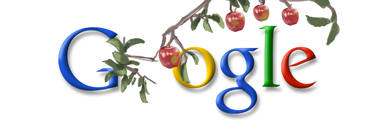
"This is the very first animated doodle that we've done," says Lopez. "It's based on the famous story on how Newton came up with the theory of gravity—that was inspired by an apple falling. The only way we could to it justice, to give our customers the feeling of surprise that Newton felt, was to make the apple fall in the doodle. So in the animation an apple drops in the middle of the page, and bounces a couple of times. We had a lot of fun developing in our geeky way—it's all JavaScript and code, not Flash."
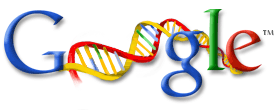
"Because we like to associate our brand with discovery and technology, it was a natural fit to do this for the 50th anniversary of Dr. James Watson discovering the structure of DNA," says Hwang. "In the original doodle, the helix were not crossing over correctly. Within minutes of posting it we started getting emails and calls from around the world from geneticists saying 'THIS IS NOT A DOUBLE HELIX,' 'URGENT!' It took me awhile to figure out they were talking about this tiny, tiny colored bar. We quickly fixed it and re-launched the doodle and the emails immediately changed to 'thank you so much!'"
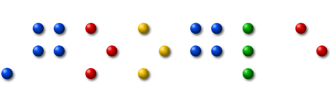
"We were able to catch a mistake on this one before it went live, thanks to one of our staff. When I sent the original draft around the company, one our engineers told me I had a typo. I was really confident I had been careful, so I asked him how he knew and he said, 'well, I'm blind.' He was able to see the mistake—an extra dot on each of the Os—because he still had 1% of his sight remaining. I was so grateful that he was able to catch that."
"It's always amazing to know a simple doodle can have an impact. After this went up a Canadian non-profit supporting the visually impaired wrote us to say just because of our doodle, web traffic to their website increased by ten-fold."
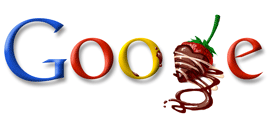
"It was a design decision," says Hwang "to have the strawberry represent the G and the stem represent the L. But I guess the stem was too short and people didn't make the connection. I was getting phone calls in the middle of the night after it went up saying we forgot the L. So I knew it was going to be a long day."
"The connections our users came up with to figure out the meaning of the missing L were amazing—things I wouldn't have thought of in my wildest dreams—like it was a tribute to the 16th century poet Barnabe Googe. Apparently he wrote quite often about unrequited love. Some made a connection to a bassist Debbie Googe, part of My Bloody Valentine. So many theories were going around that we had to put out an official company blog post to users telling them that the stem was the L."
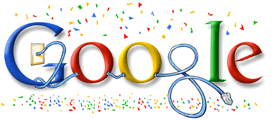
"One of the key internet anniversaries fell on January 1st, the invention of TCP/IP—a set of communications protocols that powers the internet—and since we traditionally do a New Year's doodle," says Hwang, "we were struggling to come up with a design that could work for both. We finally embedded a hidden message in the confetti 'SYN SYN/ACK and ACK' which any network engineer will recognize."
MOUNTAIN VIEW, Calif.--They've celebrated Pac-Man's anniversary, Einstein's birthday, the World Cup, the Fourth of July, Persian New Year, the Olympics, U.S. elections, and just about everything in between. Who are they? Google's Doodlers, of course.
A band of artists whose job it is to translate special events into those colorful, whimsical versions of Google's corporate logo, the Doodlers almost certainly have one of the best jobs in the world.
This team's members mix artistic skills with an ability to fit into Google's culture--meaning they can speak engineering and hold their own among the uber-geeks--in order to do the one thing at Google designed specifically to put a smile on people's faces the world over.
After working on a story about Google's creation of a special playable Pac-Man doodle back in May, I arranged for a visit with the Doodlers to witness their process and the creation of an actual doodle. So it was on a sunny Tuesday morning last month, I found myself among the Doodlers in a small conference room at the search giant's headquarters here.
A brief history
A little context first. In 1998, Google co-founders Larry Page and Sergey Brin decided to spoof the whole "out of office" idea by putting up a Burning Man logo behind the Google site's corporate logo while the two were at the annual arts festival in the Nevada desert. "While the first doodle was relatively simple," a corporate history of the Doodle recalls, "the idea of decorating the company logo to celebrate notable events was well received by our users."
In 2000, "Larry and Sergey asked current [Google] Webmaster Dennis Hwang, an intern at the time, to produce a doodle for Bastille Day," the history continues. "Pleased with the result, Dennis was then appointed Google's chief doodler and doodles became a regular occurrence on the Google home page."
The first doodle signaled that Google's co-founders were attending Burning Man. (Credit: Google)
Today, the team is made up of five people--chief doodler Micheal Lopez and doodlers Susie Sahim, Jennifer Hom, Ryan Germick, and Mike Dutton.
And as part of my visit, they agreed to let me listen to their discussions about--and see their concepts for--future creations, so long as I didn't publish anything before September 4, when one of the new doodles celebrating the discovery of the Buckyball, would run worldwide.
It's notable that the doodle was running globally because just a fraction of the total creations are meant for a world audience. Most of their work is aimed at specific countries and celebrates local events, such as the birthdays of those countries' famed composers, scientists, and artists or national days of independence. Regardless of whether a doodle is meant for the eyes of billions or just a fraction of that, Lopez said, the creative process is basically the same: the team tries to find a way to conceptualize the event and then tries to find the most fun representation of that idea.
Each year, the team creates about 200 doodles, and with each, it tries to instill Google's technology and its culture.
"The company feels pretty good about it. With all our products, we think of the user first, and this is another example where we really enjoy sharing....We get to have a human hand in our company as part of our interaction with users," said Germick, who led the Pac-Man effort.
Checking the facts
With huge audiences viewing the doodles, those on the team know that it's important their work accurately represents the subject matter. Because if they get it wrong, the public will let them know.
For example, said Lopez, when the team put out a doodle commemorating the discovery of DNA, "we actually had drawn the double helix the wrong way...Scientists started writing us... [and] we revised it on the fly."
That's why, Germick said, when working on a doodle celebrating Pi Day--March 14, or 3/14--"I made sure to get a Princeton Ph.D.'s check on my representation of different geometric equations before I pushed [the doodle] out to hundreds of millions of users."
While team members will often have days, or even weeks, to finish their creations, that's not always the case. Hom recalled the day when water vapor was discovered on the moon, and it was decided that the team should get a doodle up that same day. "It looked like we had inside information," Hom said,"but really, we were reading the news."
When the so-called 'missing link' fossil was found, the team put up this logo within hours. (Credit: Google)
When the so-called "missing link" fossil, was found in 2009, paleontologists felt it might fill in holes in their understanding of primate evolution, and the news created a splash worldwide. At the time, several of the Doodlers were at an awards ceremony in New York. But this piece of news was considered such geek manna that it was decided on the spot that Google needed to put up a doodle celebrating it. There was no time to lose, Germick said. Within hours, the resulting Doodle was bringing word about the fossil's discovery to untold millions.
Concepts
While the Pac-Man doodle would have made the news any time, it was particularly notable because it was the first example of a special logo that was fully playable and interactive. But over the years, the team has experimented with a number of dynamic doodles. Among them are the celebration of Isaac Newton's birthday in which an apple falls from a tree, a UFO's creation of a series of crop circles, and one that people could click to collect candy wrappers. That one, of course, ran on Halloween.
After about half an hour of sharing the history of Doodles, it was time for the team to get down to business: discussing current projects and giving one other feedback on their progress.
Generally, one person is assigned a specific doodle, and each usually works on two or three at a time. This means that as a team, they can make progress on a lot of doodles at once.
The first concept doodle they discussed while I was in the room was one that was scheduled to--and did--run in Russia on August 19 celebrating the 50th anniversary of the space flight of Belka and Stelka, the two Russian dogs who became the first animals to go into space--and return alive.
Sahim was creating it. Her design, I was told, was inspired by the famed Nintendo franchise, The Legend of Zelda.
At this point, just two days prior to the doodle's publication, Sahim had already gotten the sign-off from a Google marketing manager in Russia, who had reviewed and approved it.
Next up was a doodle celebrating the 205th birthday of Danish ballet dancer and choreographer August Bournoville, which was scheduled to--and did--run on August 21.
This is one of the doodles--celebrating August Bournoville--that the team discussed during CNET's visit. (Credit: Google)
Dutton explained that he had wanted to give the doodle a "dreamy feel," a "lost-edge quality," and a sense that the "body mass is fading." In the concept sketch, one could see a chair fading a bit into the background. Next up was a doodle commemorating Ukraninan Independence Day on August 24, and then one for the 213th birthday of "Frankenstein" creator Mary Shelley on August 30. The Shelley doodle ran in the U.K. that day. In Lopez's conception, the doodle depicted a hallway in Dr. Frankenstein's home to pay homage to Shelley.
I asked why it was important to commemorate Shelley's 213th birthday, rather than one with a rounder number. Lopez said that Google simply likes to celebrate anniversaries and birthdays. "We're not going to wait for a big, round number," Lopez said. "We want to do it now."
Of course, as Germick put it, by celebrating birthdays like Shelley's 213th, it maintains the "element of surprise...We want to be somewhat serendipitous."
Buckyball
After discussing a couple of more potential doodles, it was time to see some early concepts for a doodle celebrating the 25th anniversary of the discovery of buckminsterfullerene, a molecule that, Wikipedia says, is "composed entirely of carbon, in the form of a hollow sphere, ellipsoid, or tube." Spherical fullerenes are known as "Buckyballs" because these compositions have some of the same elements as geodesic domes, which were invented by Buckminster Fuller.
This logo was created to commemorate the 25th anniversary of the discovery of buckminsterfullerene.
(Credit: Google)
These molecules are commonly used in science, particularly in materials science, nanotechnology, and electronics, according to Wikipedia, yet they are also seen in the design of many different kinds of soccer balls.
That's why, when Hom began drawing her concept for a Buckyball doodle on the whiteboard, she incorporated what looked to everyone like a soccer ball. "Let's just re-use the World Cup doodle," someone joked.
Hom explained that she was thinking of two different ideas for the final design. One was slightly interactive, she said, and would feature a tiny particle rotating in circular motion around the fullerene. "Hopefully, this would spark user interest," she said, "and they'd mouse over it. And when they do, it would zoom in to a gigantic Buckyball. The user's mouse would cause it to rotate and spin."
She said that if that approach wasn't appealing to the team, she had also been conceiving of a static doodle.
I asked about the animation in her interactive idea. Germick said if they went in that direction, they'd "probably try to con an engineer into working with us in their 20 percent time." He was referring to the Google tradition of giving employees 20 percent of their work time to address personal projects.
"Some of the people I'm talking to about animating this are Buckminster Fuller fanatics," Hom said.
Indeed, she said that working on the project had felt like being in school because she felt a lot of pressure to get it right. "If I get it wrong," she said, "then everyone's going to be upset."
At Google's Silicon Valley corporate headquarters, the artists painting on digital canvases are producing works of art that will be viewed by millions... but disappear in just 24 hours.
They are the creators of Google's Doodles, the often playful illustrations that regularly transform Google's home page to mark things like holidays... famous birthdays... and notable discoveries and inventions.
If you happened to visit Google any time yesterday, you saw a celebration of the 20th anniversary of the launch of the Hubble space telescope.
"Just doing a little rough sketch where things are going to go, and hope that the engineers at NASA do not check this for authenticity,” said Micheal Lopez, who was creating the Hubble Doodle the day we visited Google.
"Space will be back here, and the Earth horizon behind it, so you can get the sense that it's doing its orbits around the Earth,” he said. “One quick, little brushstroke. I think that's good."
Lopez leads the team of Google Doodle designers, four artists whose work is seen not only on Google's American website, but on Google home pages for more than 100 countries around the world.
Ryan Germick was creating the Doodle that appeared on Google's British website Friday - St. George's Day, honoring the dragon-slaying knight.
"St. George's day is important,” Germich said. "My father's name is George. So, you know, that's a little special personal interest to me."
Jennifer Hom is working on a Doodle for Google's Czech website.
"It's the birthday of Komensky; he was an educator in the Czech Republic," she said.
Susie Sahim is creating a doodle for the Google home page in Spain for the birthday of a renowned naturalist.
"His name is Felix Rodriguez de la Fuente,” Sahim said. “So the sun is creating the O. And the two wolves together make the G. And his body much more vertical, making the L."
The doodlers take their art seriously. Jennifer Hom said Rembrandt, Caravaggio and Van Dyke were good reference points for the style used in their Doodles.
From emulating the masters to imitating cartoons, Sahim says the Doodlers do it all.
"We could do acrylic, we could do, you know, oil pastel," Sahim said. "There's all kinds of possibilities out there."
"You can make this logo look like it's been made out of anything," Blackstone said.
"Yeah, pretty much," said Sahim.
During this year's winter Olympics, Google Doodles recognized a different event every day.
And when “Sesame Street” turned 40 last year, Muppets moved onto Google home pages around the world.
The doodlers come up with ideas in casual pitch meetings, largely based on the calendar and what’s going on in the world, looking for ideas they call “Googley” - art, science and technology, steering clear of anything too commercial or political.
Google Doodles have become an online art extravaganza, but the first doodle, put up by company founders Larry Page and Sergey Brin in 1998, was much simpler - a tribute to the Burning Man Festival.
Dennis Hwang, one of the earliest Google workers, was a student intern when Page and Brin noticed he could draw and suggested he dress up the logo.
"For the first six or seven years, I was pretty much the only one creating these designs," he said.
"My first one was for Bastille Day, I think in year 2000,” he said. “And I remember nervously putting up what I think of now as a very, very rudimentary, simple design."
In those days Doodles appeared only occasionally. Hwang was doing something that in many companies would be forbidden: Altering the logo.
"The first rule is leave the company identity alone, keep it consistent,” Hwang said. “You look at Coca-Cola or McDonalds or Starbucks, anywhere in the world, and the symbols you see are very consistent."
But Hwang kept playing with Google's logo, even as it was becoming more famous.
“Larry and Sergey like to challenge conventional wisdom,” Hwang said, “so they asked the question: ‘Hey, why not have fun with our company branding and logo?’”
Of course, sometimes the logo doesn't seem to "say" Google at all, like one marking the invention of the bar code, and only those who know Braille could read what the Doodle marking Louis Braille's birthday said.
"I think one of the things we try to do is make sure that you can actually see the Google logo, every single time,” said Germick. “I know there's been some concepts that I've done where, you know, these guys are scratching their heads, going, ‘Where does it say Google?’”
In the annual competition "Doodle 4 Google," kids are invited to submit their own Doodles, with $15,000 awarded for a college scholarship fund.
"But I think the biggest thing of all, that's really exciting for the kids, is the fact that they get their Doodle put on our home page for hundreds of millions of people to see,” said Lopez.
One Doodler laughed, “I saw some ‘Doodle 4 Google’ winners, and I was, like, Wow, I need to step up my game!”
The Doodles seem to be getting more ambitious all the time, using animation for Sir Isaac Newton's birthday this year. And for Halloween, Ryan Germick created a Doodle that was a trick... as well as a treat.
"If you clicked on it, then the whole logo became candy,” he said. “And then, if you clicked on it again, there was just a big, huge pile of candy. You couldn't see the logo anymore."
"And if you clicked on it another time, it was just wrappers, you know?"
The Doodles make opening Google’s homepage a little like unwrapping candy... there may be a surprise inside.
This year’s winning “Doodle 4 Google” design will be featured on Google’s homepage on May 27, 2010.
Think back to those doodles you've inked in the margins of your notepad in school, at work or while listening on the phone.
Now imagine more than a billion people looking at your doodles in a given day. Better yet, imagine getting paid for them.
Micheal Lopez, who heads the team of doodlers at Google, never takes credit for his doodles. It's a team effort, he says.
This happens at Google. The search-engine giant has a team of doodlers who brighten Google's plain home page with colorful illustrations -- all of them variations on the word "Google" -- for holidays and special events such as the Vancouver Winter Olympics.
During the Olympics, which end Sunday, that means a different home-page doodle -- depicting everything from curling to hockey -- for each of the 17 days of the games. There's no set number on how many doodles Google does in a year, although the creations are appearing on its site more often. (Click here for a Google doodle history.) However, there is one rule for how a doodle should look: It must incorporate some form of the word "Google."
"We have a lot of fun and we like to innovate," says Micheal Lopez, the Web designer who heads the small team of doodlers based at Google's headquarters in Mountain View, California.
Lopez says employees from all over Google contribute ideas for doodles. On a few occasions, guest artists such as Jim Lee of DC Comics or Eric Carle, author of "The Very Hungry Caterpillar," also have contributed doodles.
CNN talked with Lopez about why Google, which is known for its clean Web design, changes its logo and what the company hopes to communicate to its users through the doodles.
Why change the Google logo?
Because it's fun. I think that was the idea early on way back when [Google co-founder] Sergey [Brin] did our first doodle [in 1998] for the Burning Man [an annual festival in the Nevada desert]. It was a fun way to tell our users where they were going for the day. That basically translates into the holidays and celebrating different events, things that are relative to the culture.
How do you come up with ideas for doodles?
We all have our own ways of coming up with inspiration, but for me it's definitely doing the research into that particular culture or that particular day or that particular holiday. If it's a holiday that is recurring such as Valentine's Day or a Halloween doodle, I think one of the things that we always try to do is to come up with something fresh and new. And the way we get inspired to do things like that are just collaborative. We just bounce ideas off each other.
Do you ever take stances on social or political issues with doodles?
We'd probably never do that. Again, we're not trying to make any kind of statement. We want to celebrate things that are fun and a reflection of the Google culture.
When you say Google culture, what do you mean?
There's a certain fun and quirkiness involved in everything we typically do. We do a lot of collaboration. The environment here at Google revolves around innovation and technology and that's what we try to reflect through our doodles. We try to reflect that particular type of culture. That's why we celebrate a lot of inventors. We do a lot of technology doodles.
MOUNTAIN VIEW, CA (KGO) -- It may be the world's most widely viewed art; it sits atop the most valuable piece of real estate on the Internet -- the artwork on Google's home page.
Michael Lopez
Michael Lopez is Google's lead web designer. He is part of the team that creates the Google doodles.
They celebrate birthdays like Frank Lloyd Wright's; moments in history like the landing of the Mars rover or holidays like Valentine's Day.
"When we have an idea, a great concept, as long as it's with it's something relative to Google and the technology and the culture," Lopez said.
The celebration of the discovery of DNA elicited calls from geneticists who said the colors were wrong.
"So we had to make a quick color tweak," Lopez said.
The Google doodles started more than 10 years ago when Google founders Larry Page and Sergey Brin took off for the Burning Man festival.
"It was kind of an out-of-office message for our users so Sergey put up a Burning Man logo on our home page," Lopez said.
That was 1998. Now there have been more than 500 Google doodles.
It really is the world's largest art gallery. Doodles on the Google home page have been seen by billions of people.
So how does it work?
"We start with sketches, writing on paper, napkins, on the walls, the office, everywhere," Lopez said.