The Winter Games have arrived on orkut

Even in places where "winter" means occasionally putting on a thin sweater, the Winter Games are attracting an ever larger fanbase. While a few of the 15 sports aren't the most familiar ones (ever heard of Skeleton before?), you can use orkut to learn more and get engaged by joining the Winter Olympics 2010 community.

Napoleon Orda's Birthday

Source: http://www.google.com/logos/orda10-hp.gif
Napoleon Orda (February 11, 1807 – April 26, 1883) was a Polish-Lithuanian musician, pianist, composer and artist.

Napoleon Orda was born in the village of Varacevičy in the Pinsk district of Minsk guberniya (now Ivanava Raion, Brest voblast, Belarus) in his father's manor. His father Michał Orda was an impoverished noble and the marshal of the powiat of Kobryn. After finishing Svislach gymnasium in 1823, he started mathematical studies at the Vilno University. However, his university career came to an end on August 27th, 1826 when he was arrested by the Russian secret police for taking part in an secret student society "Zarane", which was active in Svislach and Belastok gymnasiums. Although he was released soon afterwards, he was expelled from the university and was not allowed to continue his studies. [Read more on Wikipedia]

Orda on a 19th century lithograph

New Year Celebration: Window Paper Cutout

Source: http://www.google.com/logos/papercut10-hp.gif
Chinese Paper Cutting or Jianzhi (Chinese: 剪纸, jiǎn zhǐ) is the first type of papercutting design, since paper was invented by Cai Lun in the Eastern Han Dynasty in China. The art form later spread to other parts of the world with different regions adopting their own cultural styles. Because the cut outs are also used to decorate doors and windows, they are sometimes referred to "chuāng huā" (窗花), meaning Window Flower. [Read more on Wikipedia]

Natsume Soseki's Birthday

Source: http://www.google.com/logos/soseki10-hp.gif
Natsume Sōseki (夏目 漱石, February 9, 1867 – December 9, 1916), born Natsume Kinnosuke (夏目 金之助), is widely considered to be the foremost Japanese novelist of the Meiji period (1868–1912). He is best known for his novels Kokoro, Botchan, I Am a Cat and his unfinished work Light and Darkness. He was also a scholar of British literature and composer of haiku, Chinese-style poetry, and fairy tales. From 1984 until 2004, his portrait appeared on the front of the Japanese 1000 yen note. [Read more on Wikipedia]

Natsume Sōseki in 1912

Sami National Day

Source: http://www.google.com/logos/saminationalday10-hp.gif
The Sami National Day falls on February 6 as this date was when the first Sámi congress was held in 1917 in Trondheim, Norway. This congress was the first time that Norwegian and Swedish Sámi came together across their national borders to work together to find solutions for common problems.

In 1992, at the 15th Sámi Conference in Helsinki, a resolution was passed that Sámi National Day should be celebrated on February 6 to commemorate the 1st Sámi congress in 1917. Sami National Day is for all Sámi, regardless of where they live and on that day the Sámi flag should be flown and the Song of the Sami People is sung in the local Sámi language. The first time Sami National Day was celebrated was in 1993, when the International Year of Indigenous People was proclaimed open in Jokkmokk, Sweden by the United Nations.

Since then, celebrating the day has become increasingly popular. In Norway it is compulsory for municipal administrative buildings to fly the Sami flag on February 6. Particularly notable is the celebration in Norway's capital Oslo, where the bells in the highest tower of Oslo City Hall play the Sámi soga lávlla as the flags go up. Some larger places have taken to arranging festivities also in the week around the Sami National Day.

Through pure synchronicity, this date also happened to be when representatives of the Sámi of the Kola Peninsula used to gather annually, meeting with Russian bureucrats to debate and decide on issues of relevance to them. This organ, called the Koladak Sobbar, has been dubbed the 'first Sámi Parliament' by the researcher Johan Albert Kalstad. This did not influence the choice of the date as the Sámi People's Day, since the people present did not know about it - the Koladak Sobbar only existed during the late 19th century, and was only 'rediscovered' by Kalstad in the current Millennium


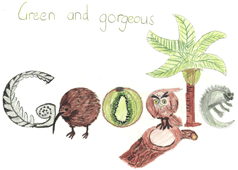
Doodle 4 Google New Zealand

Source: http://www.google.com/logos/d4g_nz10-hp.gif

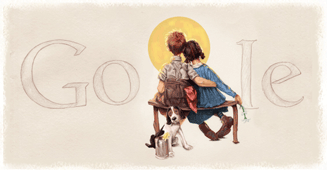
Norman Rockwell's Birthday

Source: http://www.google.com/logos/rockwell10-hp.gif
Norman Percevel Rockwell (February 3, 1894 – November 8, 1978) was a 20th-century American painter and illustrator. His works enjoy a broad popular appeal in the United States, where Rockwell is most famous for the cover illustrations of everyday life scenarios he created for The Saturday Evening Post magazine over more than four decades. Among the best-known of Rockwell's works are the Willie Gillis series, Rosie the Riveter (although his Rosie was reproduced less than others of the day), Saying Grace (1951), and the Four Freedoms series. He is also noted for his work for the Boy Scouts of America (BSA); producing covers for their publication Boys' Life, calendars, and other illustrations. [Read more on Wikipedia]